Getting Started
What's Happening (Mental Model)
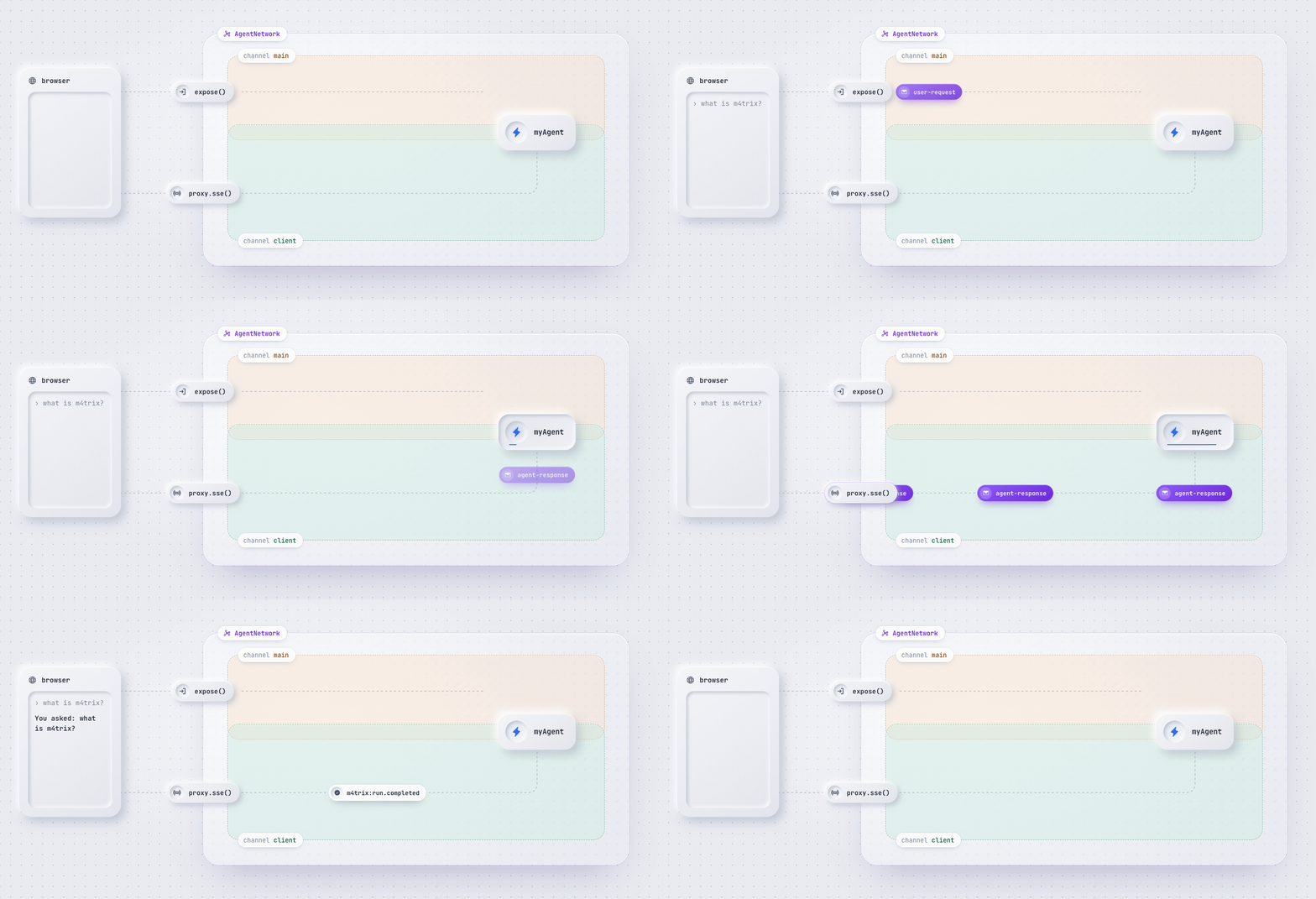
Here's the mental model for how a request flows through m4trix:
Flow Overview
- HTTP Request — A client sends a POST (or GET) to your exposed endpoint.
- expose() — Extracts the JSON payload, runs auth (if configured), and publishes a start event to the main channel.
- Main Channel — Events enter here. Agents subscribed to this channel receive the event.
- Agent(s) — Logic runs. The agent reads
triggerEvent.payload, does work (e.g. calls an LLM), and emits new events. - Client Channel — Emitted events are published to channels the agent is bound to. The client channel has an
sse()proxy, so events are streamed as SSE to the browser. - Browser — Receives SSE events and can render them in real time.
Key Ideas
- Events are typed messages. Schemas are validated at runtime via Effect.
- Channels route events. Agents subscribe to channels (input) and publish to channels (output).
- Proxies determine how events leave the system — e.g.
proxy.sse()for SSE, or a custom proxy kind of your own. - AgentNetwork wires everything: channels, agents, and the event plane.
Diagram
Next
- Next Steps — Where to go from here